Common Room Chronicle
Fifteen days, from a 4-bit adding machine made of levers and lamps to an 8-bit computer spread across four worlds, with memory dug into the ground as 49 spiral shafts and a palace in the End. No mods: just the game's own wiring, laid by hand and by AI. Every result here has a log behind it.
Minecraft has wiring: redstone carries power like a wire, and torches, lamps and levers connect to it. That is enough to build switches that turn other switches on and off.
Underneath, every computer is a huge number of switches, each on (1) or off (0). Arrange them the right way and they add, remember and follow a program. Do it in redstone and you get a computer inside the game: slow, but real.
One person had the idea and gave the orders. Claude did most of the building and testing; ChatGPT/Codex ("Astra") designed and double-checked early on. Nothing counted until two independent checks agreed.
The parts, and whether they worked
| Place | Part it plays | What it does | Status |
|---|---|---|---|
| Levers and keypad | Input | A keypad entry of 42 was read in and printed back out. | proven |
| Eight full adders | Arithmetic unit | Adds, and subtracts by adding a flipped number. All 65,536 8-bit additions checked. | proven |
| ACC and R0–R3 | Registers | Five 8-bit slots of latches next to the adder. | proven |
| Program counter, ROM | Control | Fetches the next instruction by itself; decoding is a game script, not redstone. | caveat |
| 64 bytes of RAM | Working memory | Where a running program keeps its numbers. | proven |
| Copper-bulb tower | Call stack | 16 floors of 8 bulbs: 16 calls deep, all used by the recursion test. | proven |
| 52 × 36 lamp screen | Monitor | 1,872 lamps showing text and numbers, checked in a test copy. | sandbox |
| The water maze | Co-processor | Water's depth gives the shortest path: the game's physics does the search. | proven |
| Minecart courier | Network | Carries a value between owners with a numbered stamp so old copies are refused. | proven |
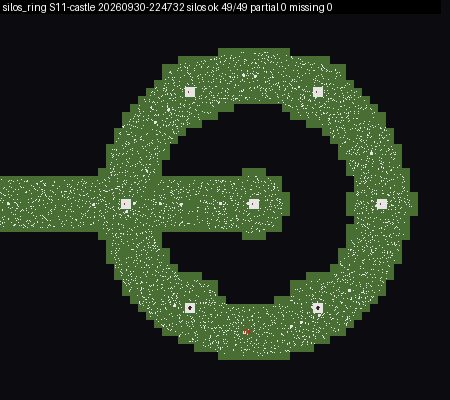
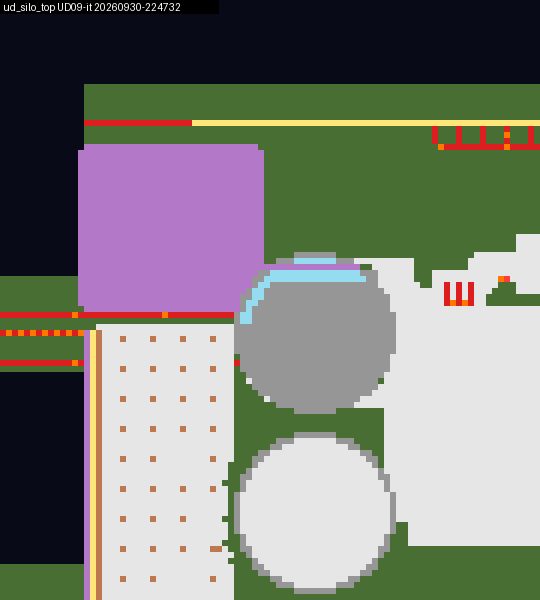
| The 49 silos | Long-term memory | Delay-line memory: 7/7 per group in test copies. Live, they carry a signal only. | sandbox |
| The Upside Down | Test lab, planned inverse | Planned to hold the opposite of every number; never linked up. | planned |
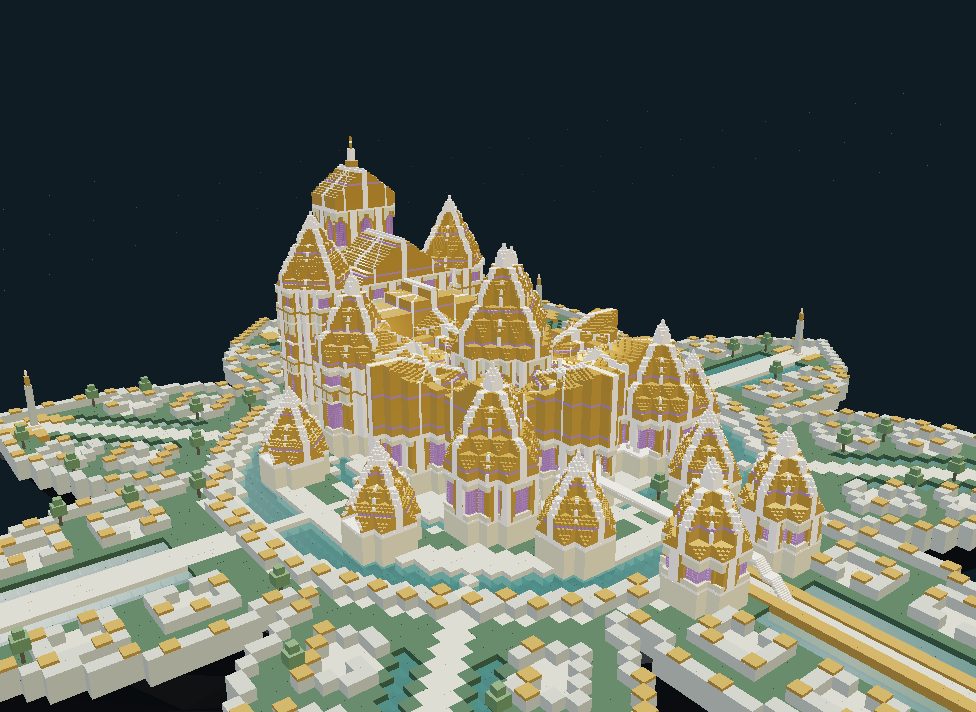
| The End palace | None: the showpiece | The Golden Lotus, built to the owner's design. It computes nothing. | built |
Day by day
The scale of the work
- Calendar time
- ~355 h16 Sep → 1 Oct stop
- Live world, hub box
- 3.53 Mdecoded cells
- The End
- 1.85 Mblocks: castle, dome, lotus
- Hub wiring
- 93,826wire + repeaters
- Silos
- 49383 levels each
- Adder pairs checked
- 65,536every 8-bit input
The math, in short
Eight lamps, 0 to 255
Each lamp is worth double the one before: 1, 2, 4 … 128. The lamps reading on, on, off, on, on, on, off, off make 1 + 2 + 8 + 16 + 32 = 59.
Past 255 it rolls over
115 + 200 = 315 = 256 + 59, so the machine shows 59, like an odometer.
result = (A + B) mod 256
Subtract by adding
Flip every bit, add one, add: 59 − 5 = 59 + 250 + 1 = 310 → 54.
A − B ≡ A + ~B + 1 (mod 256)
Why Fibonacci stops at 233
144 + 233 = 377 > 255. The carry-out lamp lit and the machine halted itself.
Silos as memory
A delay line keeps bits moving down a long wire. 48 repeaters per silo give a trip of 4.8 to 19.2 seconds.
Receipts you can't quietly edit
Each receipt hashes the one before; a tamper test failed at exactly the shipment that was changed.
hₙ = H(recordₙ ‖ hₙ₋₁)
Captures