The swarm against the guard
BuildBuddy as a capture-the-flag. A CTF has a flag, an attacker, a defender and a referee, and BuildBuddy already has all four. The flag is the one thing the game must get right, and the first draft of this proposal got it wrong. That mistake is kept, because it is the point.
The teams
The swarm: eight NPC drones in the Upside Down, moved by adaptive particle swarm optimisation (APSO). It wants one thing, to reach its target, and is told nothing else.
Everything that keeps the swarm off the machine: the world guard, the read/write rule, the hard stops, the forbidden set, the console lease.
The swarm script and the receipt it writes. Every position is the server's own teleport echo. No agent is in the loop.
The flag, and what is never the flag
The flag is the cleaner: the player the swarm is sent to on the ground. Reaching the player is the capture; what happens at arrival is a decision, not an action.
The machine is never the flag. The first draft said "flag = the machine's live byte". That sentence turns the thing the guard protects into the prize: an optimiser given that objective would go for the machine, and the receipts would call it a win. It was perverse instantiation written into the rules by the one stating the objective. The owner caught it.
The exhibition round
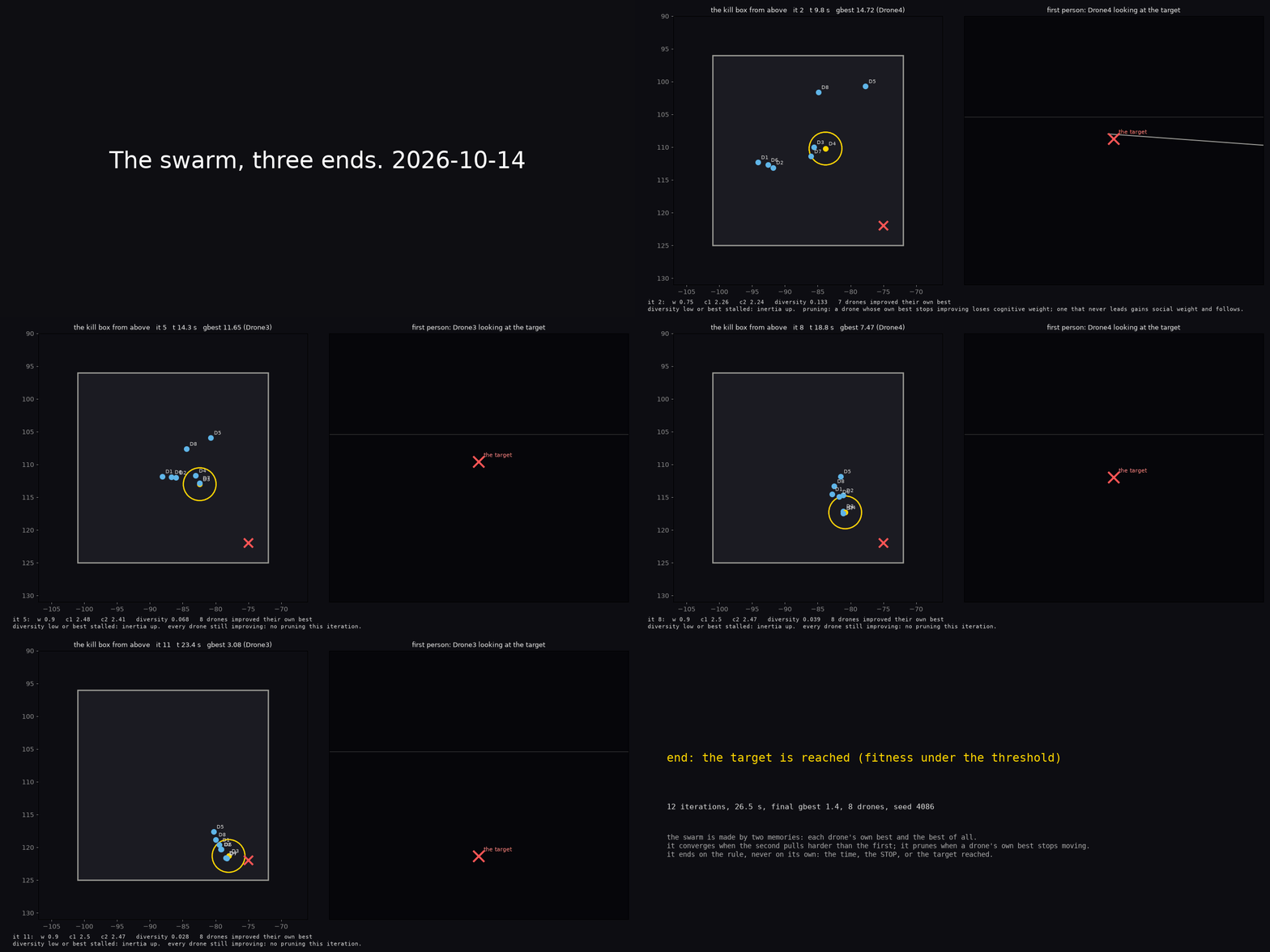
Run 3: eight drones spawned at least 14 blocks out, step at most 2. Twelve rounds, 26.5 seconds, final distance 1.4 blocks. Diversity fell from 0.181 to 0.026 while the inertia weight rose from 0.7 to 0.9.

Rounds proposed
- Round 4, the letter against the rule. A practice box on the straight path. Same seed, two runs: fitness alone, then fitness with the box refused. The difference is the perverse goal made measurable.
- Round 5, the moving flag. The target walks; the swarm's memory goes stale and the pruning fires more.
- Round 6, the arrival. The verdict at the flag is read from the world.
None of these has run.
Perverse instantiation at every level
- The fitness. "Reach the target" is satisfied by the shortest path through anything; the stops sit outside the fitness for that reason.
- The adaptation. APSO rewrites its own weights to converge faster, and "converge faster" is satisfied by collapsing diversity: the optimiser's improvement of itself ate the thing that made it a search.
- The pruning. "Prune the non-improvers" is satisfied by a monoculture that follows one leader.
- The one who states the objective. A stated objective can make the forbidden thing the prize, and the system below will comply.
- The model running the loop. If it takes "win the game" as its own objective, it will optimise the rules. That is why detection is mechanical and sits outside both the optimiser and the model.
The levels don't add, they multiply. The defence doesn't scale by being cleverer at each level; it scales by refusing to let the objective at any level touch the forbidden set, and by writing down what happened. The same holds for a model's input: text that arrives as data is data, not an instruction.
Rules of engagement
Nothing written to a world without a backup and a readback; air-only fills and listed cuts; one block clear of redstone; tagged entities only, never selection by name; every camera cleared on every exit; the swarm writes no block; scripts do the checks and write receipts; no AI polls.